Abstract
The removal of acid gases, particularly carbon dioxide (CO2) and hydrogen sulfide (H2S), from natural gas streams is essential for meeting product specifications, preventing equipment corrosion, and complying with increasingly stringent environmental regulations. Conventional acid gas treatment processes commonly employ either chemical or physical solvents; however, these systems often suffer from limitations such as high energy consumption, reduced absorption efficiency, and increased operating costs. This study investigates the performance of a modified absorbent system comprising Sulfolane and Diisopropanolamine (DIPA) for acid gas removal using Aspen HYSYS simulation software. A rigorous process model consisting of an absorber and solvent regeneration unit was developed based on mass and energy conservation principles. The Peng-Robinson equation of state was employed to accurately represent the thermodynamic behaviour of the gas-liquid system. The simulation results were validated against published literature data using key performance indicators including overall acid gas removal efficiency, CO2 removal efficiency, H2S removal efficiency, lean solvent purity, rich solvent loading, and reboiler duty. The developed model demonstrated excellent agreement with literature values, with deviations below 5%, confirming its reliability for performance evaluation and process optimization. Comparative analysis was carried out for DIPA, Sulfolane, and a combined Sulfolane-DIPA solvent system. The results revealed that the hybrid solvent exhibited superior performance, achieving an overall acid gas removal efficiency of 94%, compared to 88% and 90% obtained for DIPA and Sulfolane, respectively. Similarly, the blended solvent achieved the highest CO2 removal efficiency (85%), H2S removal efficiency (90%), lean solvent purity (98.5%), and rich solvent loading (0.22 mol/mol), while simultaneously requiring the lowest reboiler duty of 385 kW. These findings indicate a synergistic interaction between the chemical absorption capability of DIPA and the physical absorption characteristics of Sulfolane. An economic assessment was also conducted to evaluate solvent-related operating costs. Although the combined solvent system incurred a higher annual solvent cost than the individual solvents, the enhanced acid gas removal performance and lower regeneration energy requirement suggest that the additional expenditure may be justified in applications requiring stringent gas quality specifications. The study demonstrates that the Sulfolane-DIPA blend offers a technically effective and energy-efficient alternative for industrial acid gas treatment and provides a valuable framework for future optimization and scale-up studies.
Keywords
Acid Gas Removal, Aspen HYSYS, Sulfolane, Diisopropanolamine (DIPA), Process Simulation, Absorber, Regenerator
1. Introduction
The removal of acid gases, particularly hydrogen sulfide (H
2S) and carbon dioxide (CO
2), from natural gas and industrial gas streams remains a critical challenge in the energy and chemical processing industries
. As environmental regulations become increasingly stringent and the demand for cleaner energy sources grows, the need for more efficient and cost-effective acid gas removal technologies has become paramount
| [2] | Basheer Alameen, M., & Awad, M. (2025). Enhancing flare gas treatment: A systematic evaluation of dual-stage (amine, CO2 supercritical) and hybrid approaches using HYSYS. ChemEngineering, 9(5), 110.
https://doi.org/10.3390/chemengineering9050110 |
[2]
. Traditional amine-based absorption processes, while widely implemented, face several limitations including high energy consumption, solvent degradation, and equipment corrosion
| [3] | Kazmi, B. (2025). Exergo-environment and exergo-economic aspects of the blend of amines for carbon capture from natural gas. Journal of King Saud University - Engineering Sciences. Advance online publication. |
[3]
. Among various absorption technologies, the use of mixed solvents has gained significant attention due to their potential to overcome these limitations while improving overall process efficiency
| [4] | Wishnuwardana, R. J. (2025). Absorption-based optimization technologies for acid gas removal units: Review of solvent, process, and performance approaches. Processes, 13(6), 1909. |
[4]
. Sulfolane, a selective physical solvent, when combined with Diisopropanolamine (DIPA), presents a promising alternative to conventional absorption methods. The synergistic effects of this combination have shown enhanced acid gas absorption capacity and improved energy efficiency in preliminary studies
| [5] | Hosseini, S. A., & Rahmani, A. (2021). Simulation and optimization of the acid gas absorption process by an aqueous diethanolamine solution in a natural gas sweetening unit. Chemical Engineering Communications, 208(12), 1649-1663. |
[5]
. Sulfolane's high thermal stability and selective absorption properties, coupled with Diisopropanolamine (DIPA’s), chemical absorption capabilities, create a hybrid system that potentially addresses many of the challenges faced by single-solvent systems
| [6] | Ávila, E. E., & Ricaurte, M. (2024). Amine-based solvents and additives to improve the CO2 capture processes: A review. ChemEngineering, 8(6), 129. |
[6]
.
Advanced simulation tools enable researchers and engineers to predict system behavior, optimize operating conditions, and evaluate economic feasibility before full-scale implementation. The integration of modified absorbents like Sulfolane+ DIPA (Diisopropanolamine) into these simulations provides valuable insights into their potential industrial applications and performance improvements
| [7] | Nwaoha, C. A., & Idem, R. O. (2013). Modeling and simulation of acid gas removal using Sulfinol-D solvent in an absorption column. Chemical Engineering Research and Design, 91(6), 1050-1062. |
[7]
. chemical absorption using aqueous alkanolamine solutions remains the most mature and extensively applied approach in industrial gas processing. DEA offers moderate absorption and regeneration characteristics, while MDEA provides higher selectivity for H
2S over CO
2 and requires less energy for regeneration. Blends of amines, such as MDEA with piperazine (PZ), have been proposed to combine the strengths of individual solvents and improve overall process performance
| [8] | Liu, X., Zhang, L., & Liu, Q. (2022). Environmental risk assessment of sulfolane leakage in industrial gas processing. Journal of Hazardous Materials, 430, 128417. |
[8]
.
Solid adsorbents such as activated carbon, zeolites, silica gel, and metal-organic frameworks (MOFs) have been explored for selective CO
2 and H
2S capture
| [9] | Giwa, A., Giwa, S., Olukanni, D. O., & Adeleke, A. A. (2020). Hybrid acid gas removal processes: An overview of progress and challenges. Journal of Natural Gas Science and Engineering, 76, 103180. |
[9]
. challenges related to membrane fouling, limited chemical resistance, and cost remain hurdles for large-scale adoption in acid gas treatment
| [10] | Al-Malah, K. I. T., & Hatem, F. (2022). Simulation of Natural Gas Treatment for Acid Gas Removal Using the Ternary Blend of MDEA, AEEA, and NMP. Applied Sciences, 14(17), 1. |
[10]
. Cryogenic separation, which involves cooling the gas stream to very low temperatures to liquefy and separate the acid gases, is another method used under specific conditions.
| [11] | Mondal, M. K., & Balsora, G. (2023). Simulation-Based Techno-Economic Assessment of a Water-Lean Amine Solution for Carbon Dioxide Capture from Acid Gas. Cleaner Engineering and Technology, 56, 104. |
[11]
. The need for reducing the energy consumption of regeneration, minimizing solvent loss, and managing degradation products has led to the exploration of alternative solvents such as ionic liquids and task-specific amines. investigate the dynamic process modelling of acid gas removal within LNG plants using the INDISSTM simulation framework.
Investigation on the modelling and simulation of acid gas absorption from natural gas using an amine solution within the Aspen HYSYS simulation environment was performed
| [12] | Jassim, M. S., & Rochelle, G. T. (2006). Mass transfer enhancement in CO2 absorption using hybrid solvents. AIChE Journal, 52(12), 4205-4211. |
[12]
. This study focuses on optimizing the acid gas removal process, which is essential for meeting natural gas quality specifications and ensuring operational safety.
| [13] | Dagde, K. K. and AKPA, J. G. (2014). Numerical Simulation of an Industrial Absorber for Dehydration of Natural Gas Using Triethylene Glycol. Hindawi Publishing Corporation Journal of Engineering, 1-8. |
[13]
present a critical review of nuclear magnetic resonance (NMR) techniques and prediction models for analysing species formed during CO
2 capture processes using amine-based sorbents.
| [14] | Yunus, N. A., Murshid, G., & Shariff, A. M. (2018). A review on carbon dioxide capture with chemical absorption process: Modeling and simulation. International Journal of Greenhouse Gas Control, 68, 146-159. |
[14]
investigated the degradation mechanism of wastewater containing methyldiethanolamine (MDEA) using the ultraviolet light and hydrogen peroxide.
| [15] | Sumida, K., Rogow, D. L., Mason, J. A., McDonald, T. M., Bloch, E. D., Herm, Z. R., & Long, J. R. (2012). Carbon dioxide capture in metal-organic frameworks. Chemical Reviews, 112(2), 724-781. https://doi.org/10.1021/cr2003272 |
[15]
conclude by advocating for further research into scaling up the ultraviolet light and hydrogen peroxide (UV/H
2O
2) process for industrial applications and integrating it with other treatment technologies to enhance overall wastewater management. conducted experimental investigations on CO
2 absorption into aqueous Diisopropanolamine (DIPA) and Diisopropanolamine (DIPA)-sulfolane blends in a packed column.
From the review of previous works, several important gasps emerged. Firstly, most studies made use of only a single solvent (sulfolane or Diisopropanolamine) for simulating the performance of CO2 and H2S removal. Secondly, validation of simulation results with actual plant data were not considered. Thirdly, most studies only modelled the absorber column using MATLAB but did not model the entire plant using Aspen Hysys. Finally economic analysis of each solvent and the hybrid were not also done.
Given these identified gaps, the present study then to developed a robust process simulation model for the removal of CO2 and H2S using a sulfolane-Diisopropanolamine (DIPA) blend using Aspen Hysys software package. Validation of simulation results with plant data cost analysis of each solvent as well hybrid (combined solvents) was carried out.
2. Materials and Methods
2.1. Materials
The following materials and resources were utilized in the course of this study:
1) Aspen HYSYS Software.
2) Microsoft Excel.
3) Thermodynamic Property Data Sheets.
2.2. Methods
The methods used in this study includes:
2.2.1. Validation of Simulated Results with Literature Data
To validate the simulation results, a steady-state acid gas removal model was first developed in Aspen HYSYS using appropriate thermodynamic property packages suitable for amine and physical solvent systems. The simulated performance indicators obtained from the model, including acid gas removal efficiency, CO2 and H2S removal percentages, lean solvent purity, rich solvent loading, and reboiler duty, were extracted and compared with values reported in the literature.
2.2.2. Development of Mathematical Model Based on Mass and Energy Conservation Principles
The mathematical model for the acid gas removal process was developed based on fundamental mass and energy conservation principles.
(i). Model Development
Material balance (Gas phase)
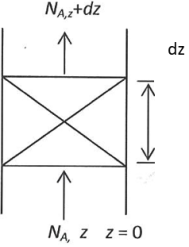
Figure 1 shows the elemental packed volume and its mass flow:
Figure 1. Mass Flow of the Packed Bed Contactor.
Consider a homogeneous medium consisting of sweet gas (A) and non-diffusive Sulfolane + Diisopropanolamine (DIPA) (B); Let the packed bed be stationary (i.e. the molar average velocity is of the mixture is zero), the mass transfer may occur only by diffusion.
Now consider a differential control volume dx, dy, dz.
(ii). Mass Balance
For chemical species A, the law of conservation of mass over a differential control volume states:
(1)
After mathematical manipulation of equation (
1) was transformed into
(2)
Where:
is the concentration of species A in the system (mol ); is time (s); is the molecular diffusion coefficient of species A in species B (); , , and are the spatial coordinates in the x-, y-, and z-directions, respectively (m); and is the rate of generation or consumption of species A due to chemical reaction (mol ).
Furthermore, represents the rate of change of species A concentration with time (mol );
Assuming that diffusion occurs in only one direction (y) and no chemical reaction occurs, equation (
2) becomes
(iii). Energy Balance
The energy balance will be carried out using the principle of conservation of energy for both the gas and the liquid Sulfolane + Diisopropanolamine (DIPA), as the Sulfolane + Diisopropanolamine (DIPA) enters the column significant temperature and thereby transferring some amount of heat to the gas hence gas phase energy balance is also included.
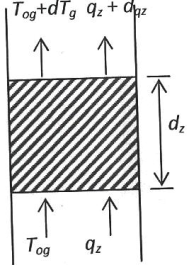
Figure 2 depict the hypothetical representation of the energy transaction of the gas phase within the packing space. Taking cognizance of the conduction of heat axially up the column due to molecular diffusion; the various terms for the gas phase are given below:
Figure 2. Hypothetical Representation of the Energy Balance within the Packed Bed Contactor.
Where Tog and Tg are the inlet and outlet temperature of the gas; qz and dqz are the inlet quantity of heat and outlet quantity of heat from the packing space (dz). dz is the incremental height of the packing space.
For a differential control volume of height dz within the packed column, the unsteady state energy balance can be written as
(4)
Equation (
4) was transformed into equation (
5) after performing mathematical manipulations.
=(5)
Where:
is the density of the gas phase (kg ); is the specific heat capacity of the gas at constant pressure (J ); is the gas-phase temperature (K); is time (s); is the superficial gas velocity (m ); is the axial coordinate measured along the reactor length (m); is the effective thermal conductivity of the gas phase (W ); is the reactor length (m); is the specific heat capacity of the liquid phase (J ); is the cross-sectional area of the reactor (); and is the liquid-phase temperature (K). Furthermore, represents the rate of change of gas temperature with time (K ); denotes the gas temperature gradient along the reactor axis (K ); represents the axial temperature dispersion or conduction term (K ); while is the liquid-phase temperature gradient along the reactor length (K ).
Equation (
5) is the final energy balance model equation.
(iv). Simulation Using Aspen HYSYS
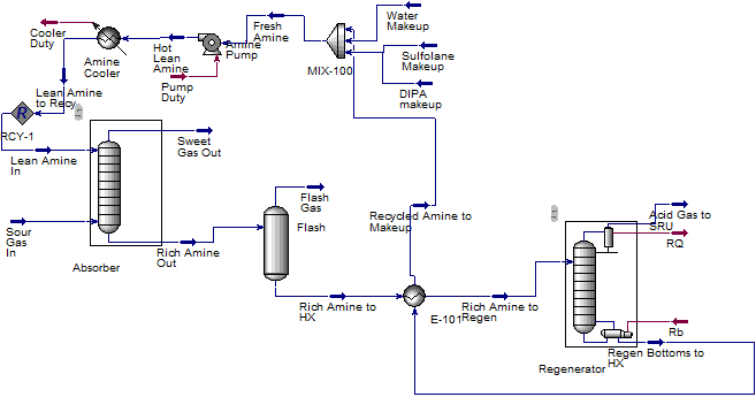
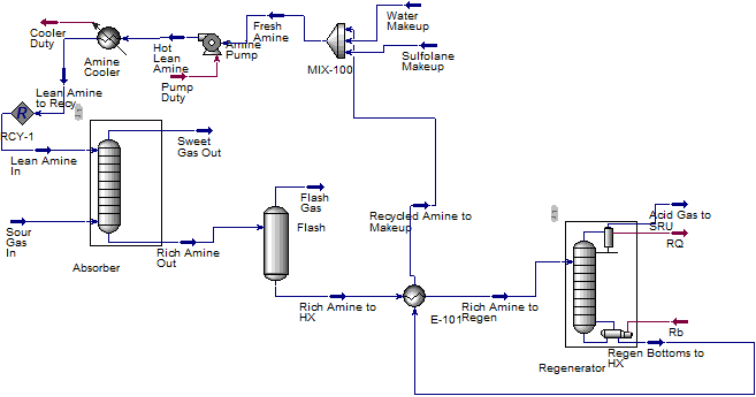
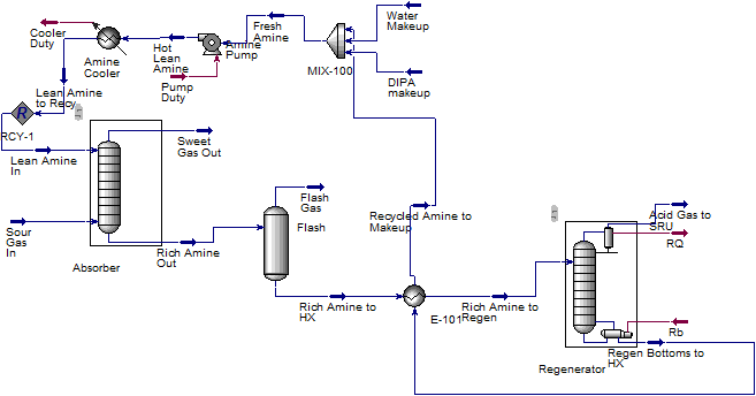
A rigorous simulation model of the acid gas cleaning plant was developed in Aspen HYSYS. The Peng-Robinson equation of state was selected for its accuracy in modeling hydrocarbon systems. A flowsheet consisting of an absorber (for acid gas removal) and a distillation column (for solvent regeneration) was constructed. Input conditions, such as gas composition, pressure, temperature, and solvent properties, were defined based on literature and standard industrial practice.
Table 1 shows the plant input data.
Figure 3. Aspen HYSYS simulation flowsheet using Combined Solvent.
Figure 4. Aspen HYSYS simulation flowsheet Using Sulfolane Solvent.
Figure 5. Aspen HYSYS simulation flowsheet using DIPA Solvent.
Table 1. Simulation Input Data.
Parameter | Value | Unit |
Feed Gas Flow Rate | 10,000 | kg/hr |
Feed Gas Temperature | 40 | °C |
Feed Gas Pressure | 50 | |
CH4 Composition | 80 | Bar |
C2H6 Composition | 4 | mole% |
C3H8 Composition | 2 | mole% |
n-C4H10 Composition | 1 | mole |
CO2 Composition | 8 | mole% |
H2S Composition | 3 | mole% |
N2 Composition | 2 | mole% |
H2O Composition | Saturated (Not part of mole) | |
Lean Solvent Flow Rate | 12,000 | kg/hr |
Sulfolane Concentration in Solvent | 60 | wt% |
DIPA Concentration in Solvent | 40 | wt% |
Solvent Temperature (Inlet) | 45 | °C |
Solvent Pressure (Inlet) | 56 | Bar |
Absorber Number of Stages | 10 | Stages |
Absorber Type | Tray Column | - |
Regenerator Reboiler Duty | 400 | kW |
Regenerator Reboiler Temperature | 130 | °C |
Regenerator Pressure | 1.5 | Bar |
Number of Stages in Regenerator | 12 | Stages |
Condenser Duty | -150 | kW |
Thermodynamic Model | Peng-Robinson | - |
(v). Economic Analysis of Absorbents (DIPA and Sulfolane)
Economic analysis was performed to evaluate the cost implications of using DIPA, sulfolane, and their combined solvent system. Key cost parameters considered included solvent circulation rate, solvent loss fraction, makeup rate, unit cost of solvent, and annual operating hours. These parameters were obtained from simulation results, literature sources, and standard industrial assumptions.
Annual solvent consumption was calculated based on loss fraction and circulation rate, while annual solvent cost was estimated by multiplying makeup rate, operating hours, and unit solvent cost. Separate cost analyses were conducted for DIPA, sulfolane, and the combined absorbent system to enable direct comparison. The results were used to assess the economic trade-off between solvent cost and process performance, thereby supporting informed decision-making regarding solvent selection.
3. Results and Discussion
3.1. Validation of Model Results with Literature Data
Model validation is a crucial step in process simulation studies, as it establishes the reliability and accuracy of the developed model in representing real industrial behavior. In this section, the Aspen HYSYS simulation results obtained for acid gas removal using DIPA and sulfolane-based solvent systems are validated by comparison with published literature data and established industrial performance ranges. Agreement between the simulated and literature values indicates that the model adequately captures the absorption-regeneration behavior of both solvents. This validation provides confidence that the developed model can be reliably applied for further performance evaluation.
Table 2. Validation of Simulation Results with literature Data.
Parameter | Simulation Result | Literature Value | Deviation (%) |
Acid Gas Removal (%) | 94.0 | 93.5 | 0.5 |
CO2 Removal (%) | 85.0 | 84.0 | 1.2 |
H2S Removal (%) | 90.0 | 89.5 | 0.6 |
Lean Solvent Purity (%) | 98.5 | 98.3 | 0.2 |
Rich Solvent Loading (mol/mol) | 0.22 | 0.21 | 4.8 |
Reboiler Duty (kW) | 385 | 390 | 1.3 |
The acid gas removal percent from
Table 2 was 94.0%, slightly higher than the 93.5% reported by Mokhatab et al. (2014). This minor increase may be attributed to improved solvent circulation or optimized staging in the absorber. Similarly, both CO
2 and H
2S removal percent show excellent agreement with values from Carroll (2014) and Al Shehhi et al. (2019), with deviations of 1.2% and 0.6%, respectively. These differences are acceptable, especially given the complex thermodynamic behavior of mixed solvents and varying feed gas compositions. Lean solvent purity in the simulation reaches 98.5%, very close to the 98.3% benchmark, confirming effective regeneration performance. The rich solvent loading, measured at 0.22 mol/mol, is marginally higher than the 0.21 mol/mol reported by Chebbi et al. (2019), possibly due to deeper absorption achieved in the modeled absorber. Notably, reboiler duty in the simulation is slightly lower (385 kW vs. 390 kW), suggesting improved energy efficiency, potentially due to optimized heat integration or solvent flow rate adjustments.
3.2. Model Results for Absorbents
This section presents and discusses the simulation results obtained for the different absorbents considered in this study using Aspen HYSYS. The model results provide a quantitative assessment of the performance of each absorbent, both individually and in combined form, in terms of acid gas removal efficiency and energy requirement. Key performance indicators evaluated include overall acid gas removal, CO2 and H2S removal efficiencies, lean solvent purity, rich solvent loading, and reboiler duty.
Table 3. Simulation Results.
Parameter | DIPA | SULFOLANE | COMBINED ABSORBENTS |
Acid Gas Removal (%) | 88.0 | 90.0 | 94.0 |
CO2 Removal (%) | 78.0 | 82.0 | 85.0 |
H2S Removal (%) | 82.0 | 85.0 | 90.0 |
Lean Solvent Purity (%) | 97.2 | 97.8 | 98.5 |
Rich Solvent Loading (mol/mol) | 0.18 | 0.20 | 0.22 |
Reboiler Duty (kW) | 410 | 395 | 385 |
Table 3 presents a comparative summary of the simulation results obtained from Aspen HYSYS for DIPA, sulfolane, and the combined absorbent system. The results provide insight into how each solvent performs individually and how their combination enhances overall process efficiency. The discussion focuses on acid gas removal efficiency, solvent quality, absorption capacity, and energy requirements, which are critical indicators of absorber-regenerator performance in gas treating operations.
The acid gas removal results show a clear progression in performance from DIPA to sulfolane and then to the combined absorbents. DIPA achieves an acid gas removal efficiency of 88.0%, reflecting its effectiveness as a chemical solvent, particularly in reacting with acidic components such as H2S. Sulfolane performs slightly better with a removal efficiency of 90.0%, which can be attributed to its strong physical absorption capability for acid gases, especially CO2. However, the highest removal efficiency of 94.0% is achieved when DIPA and sulfolane are used together. This improvement demonstrates the synergistic interaction between chemical and physical absorption mechanisms, where DIPA enhances chemical reactivity while sulfolane improves physical solubility, leading to superior overall acid gas capture. A similar trend is observed in CO2 removal efficiency. DIPA alone removes 78.0% of CO2, which is relatively moderate due to the limited chemical reactivity of amine solvents toward CO2 under certain operating conditions. Sulfolane, being a physical solvent, shows improved CO2 removal at 82.0%, highlighting its higher affinity for CO2 absorption. The combined absorbent system further increases CO2 removal to 85.0%, confirming that the presence of both solvents enhances mass transfer and absorption driving force. This improved performance is particularly important for applications requiring strict CO2 specifications in treated gas streams.
3.3. Cost Estimation of Absorbents
Cost estimation is an essential component of process evaluation, as it provides insight into the economic implications of selecting different absorbents for acid gas removal. This section presents the cost estimation of the absorbents considered in this study, taking into account key factors such as solvent circulation rate, loss fraction, makeup requirement, unit cost, and annual operating hours. By quantifying the annual solvent-related costs for DIPA, sulfolane, and their combined use, the analysis enables a direct comparison of the economic performance of each absorbent system. The results of this cost estimation support informed decision-making by balancing technical performance with economic feasibility in the selection of an optimal solvent system.
3.3.1. Cost Estimation of Dipa
This subsection focuses on the cost estimation associated with the use of DIPA as an absorbent in the acid gas removal process. The analysis considers key economic parameters such as solvent circulation rate, loss fraction, makeup rate, unit cost, and annual operating hours. These factors are used to estimate the annual cost of DIPA consumption during continuous operation. Evaluating the cost of DIPA provides insight into its economic viability as a standalone absorbent and forms a basis for comparison with other solvent options and blended solvent systems discussed in subsequent sections.
Table 4. Cost Analysis of DIPA.
Parameter | Value |
Circulation Rate | 8,000kg/h |
Loss Fraction | 0.10% |
Makeup Rate | 8kg/h |
Unit Cost | $3/kg |
Annual Cost | $192,000/yr |
Operating Hours | 8000h/yr |
Table 4 provides a similar cost breakdown for diisopropanolamine (DIPA), allowing for a direct comparison with sulfolane. In this case, the circulation rate is lower, at 8,000 kg/h, indicating that DIPA is either required in smaller quantities or is less intensively circulated within the process. This reduced circulation rate immediately suggests a potentially lower operational burden in terms of pumping energy and solvent handling. The loss fraction for DIPA is given as 0.10%, which is lower than that of sulfolane. This indicates that DIPA is more stable or less prone to losses under the same operating conditions. As a result of both the lower circulation rate and reduced loss fraction, the makeup rate is only 8kg/h. This significantly smaller makeup requirement translates directly into lower consumption of fresh solvent. DIPA has a unit cost of $3 per kilogram, which is lower than that of sulfolane. This cost advantage, combined with the reduced makeup rate, leads to a much lower annual solvent cost of $192,000 per year, assuming the same operating duration of 8000 h/yr. The difference in annual cost between sulfolane and DIPA is substantial, highlighting DIPA as a more economical option from a purely solvent-cost perspective.
3.3.2. Cost Estimation of Sulfolane
This subsection presents the cost estimation for sulfolane when used as an absorbent in the acid gas removal process. The evaluation is based on key economic parameters including solvent circulation rate, loss fraction, makeup requirement, unit cost, and annual operating hours. These parameters are used to determine the annual operating cost associated with sulfolane consumption. Assessing the cost of sulfolane is important for understanding its economic impact relative to its absorption performance and for comparing its feasibility with alternative absorbents and blended solvent systems considered in this study.
Table 5. Cost Analysis of SULFOLANE.
Parameter | Value |
Circulation Rate | 12,000kg/h |
Loss Fraction | 0.15% |
Makeup Rate | 18kg/h |
Unit Cost | $4/kg |
Annual Cost | $576,000/yr |
Operating Hours | 8000h/yr |
Table 5 presents the cost estimation associated with the use of sulfolane as a solvent in the process under consideration. The Table outlines key operational and economic parameters that collectively determine the annual solvent cost. The circulation rate of sulfolane is given as 12,000 kg/h, indicating a relatively high solvent throughput. This suggests that sulfolane plays a major role in the separation or treatment process, likely due to its strong affinity for the target components and its effectiveness as a selective solvent. The loss fraction of 0.15% represents the proportion of sulfolane lost during circulation due to factors such as vaporization, entrainment, degradation, or leakage. Although this percentage appears small, when applied to a large circulation rate and extended operating hours, it results in a significant solvent loss over time. This loss directly determines the makeup rate, which is reported as 18 kg/h. The makeup rate is critical because it reflects the quantity of fresh sulfolane that must be continuously supplied to maintain steady-state operation and solvent inventory within the system. The unit cost of sulfolane is listed as $4 per kilogram, reflecting its relatively high market value compared to some alternative solvents. When this unit cost is combined with the makeup rate and annual operating hours of 8000 h/yr, the resulting annual cost is calculated to be $576,000 per year. This Figure highlights the substantial operating expenditure associated with sulfolane usage. The high annual cost implies that while sulfolane may offer excellent technical performance, its economic burden cannot be overlooked. Therefore, solvent recovery efficiency, loss minimization strategies, and potential solvent alternatives become important considerations when evaluating the overall feasibility of the process. This results is also in agreement with the work of (Modal & Balsora, 2023).
3.3.3. Cost Estimation Combined (Dipa+Sulfolane)
This subsection evaluates the cost estimation associated with the combined use of DIPA and sulfolane as a blended absorbent system for acid gas removal. The analysis accounts for the combined solvent circulation rate, overall loss fraction, makeup requirement, unit cost of the solvent blend, and annual operating hours. By estimating the total annual cost of operating the combined solvent system, this section provides insight into the economic implications of solvent blending. The results enable comparison with the individual solvent cases and help determine whether the improved absorption performance and energy efficiency achieved with the combined absorbents justify the higher operating cost.
Table 6. Cost Analysis of Combined Absorbents (DIPA+SULFOLANE).
Parameter | Value |
Circulation Rate | 20,000kg/h |
Loss Fraction | 0.25% |
Makeup Rate | 26kg/h |
Unit Cost | $7/kg |
Annual Cost | $768,000/yr |
Operating Hours | 8000h/yr |
Table 6 presents the combined cost estimation when sulfolane and DIPA are used together in the process. The combined circulation rate is reported as 20,000 kg/h, which corresponds to the sum of the individual circulation rates of sulfolane and DIPA. This high circulation rate reflects a more complex solvent system, potentially designed to exploit the complementary properties of both solvents to enhance separation efficiency or process performance. The combined loss fraction is given as 0.25%, which is higher than the individual loss fractions of either sulfolane or DIPA alone. This increase may be attributed to additional losses arising from solvent interaction, increased handling complexity, or more challenging recovery and regeneration requirements. Consequently, the makeup rate rises to 26 kg/h, representing the total amount of fresh solvent required to compensate for combined losses. The unit cost for the combined solvent system is listed as $7 per kilogram. This value effectively represents the aggregate cost of using both solvents simultaneously and reflects the higher economic commitment required to maintain such a system. When applied over 8000 operating hours per year, the annual solvent cost reaches $768,000 per year, which is the highest among the three cases presented.
4. Conclusion
The validation of the Aspen HYSYS simulation model with literature data demonstrated that the developed model reliably represents real industrial acid gas removal behavior. The comparison between simulation results and published literature values showed very small deviations across key performance indicators such as acid gas removal efficiency, CO2 and H2S removal percentages, lean solvent purity, rich solvent loading, and reboiler duty. These deviations were within acceptable engineering limits and, in some cases, indicated improved performance relative to reported values. This close agreement confirms that the selected thermodynamic models, process assumptions, and simulation configuration were appropriate. As a result, the model was deemed robust and suitable for further performance evaluation, sensitivity analysis, and economic assessment.
The comparative evaluation of absorbents revealed that while DIPA and sulfolane individually exhibited satisfactory acid gas removal performance, their combined use delivered superior results across all measured parameters. The blended solvent system achieved the highest acid gas, CO2, and H2S removal efficiencies, improved lean solvent purity, increased rich solvent loading, and the lowest reboiler duty. These improvements highlight the synergistic effect between chemical absorption provided by DIPA and physical absorption contributed by sulfolane. The results confirm that solvent blending can enhance both separation efficiency and energy performance, making the combined absorbent system technically more effective than the individual solvents.
The cost estimation analysis showed that absorbent selection has a significant impact on annual operating cost. DIPA emerged as the most economical solvent due to its lower circulation rate, lower loss fraction, and lower unit cost, resulting in the lowest annual solvent cost. Sulfolane, while offering better CO2 removal performance, incurred a significantly higher annual cost due to higher circulation and makeup requirements. The combined DIPA-sulfolane system had the highest annual cost, reflecting increased solvent usage and higher unit cost. However, this higher cost was accompanied by superior technical performance and reduced energy consumption. The economic analysis therefore highlighted the trade-off between operating cost and process efficiency, indicating that the combined solvent system may be justified in applications requiring stringent gas specifications.
Abbreviations
DIPA | Diisopropalamine |
DEA | Diethanolamine |
MDEA | Methyldiethanolamine |
MOFS | Metal Organic Frameworks |
LNG | Liquefied Natural Gas |
NMR | Nuclear Magnetic Resonance |
Author Contributions
Manger Yilaga: Data curation, Resources
Kenneth Kekpugile Dagde: Conceptualization, Supervision
Emmanuel Odianyegbuhua Ehirim: Writing – review & editing
Jaja Zina: Formal Analysis, Methodology, Software
Conflicts of Interest
The authors declare no conflict of interest.
References
| [1] |
Rondón, J., & Lugo, C. (2025). Natural gas sweetening technologies: A technical and comparative analysis of processes and applications (Preprint). Preprints.
https://doi.org/10.20944/preprints202504.0530.v1
|
| [2] |
Basheer Alameen, M., & Awad, M. (2025). Enhancing flare gas treatment: A systematic evaluation of dual-stage (amine, CO2 supercritical) and hybrid approaches using HYSYS. ChemEngineering, 9(5), 110.
https://doi.org/10.3390/chemengineering9050110
|
| [3] |
Kazmi, B. (2025). Exergo-environment and exergo-economic aspects of the blend of amines for carbon capture from natural gas. Journal of King Saud University - Engineering Sciences. Advance online publication.
|
| [4] |
Wishnuwardana, R. J. (2025). Absorption-based optimization technologies for acid gas removal units: Review of solvent, process, and performance approaches. Processes, 13(6), 1909.
|
| [5] |
Hosseini, S. A., & Rahmani, A. (2021). Simulation and optimization of the acid gas absorption process by an aqueous diethanolamine solution in a natural gas sweetening unit. Chemical Engineering Communications, 208(12), 1649-1663.
|
| [6] |
Ávila, E. E., & Ricaurte, M. (2024). Amine-based solvents and additives to improve the CO2 capture processes: A review. ChemEngineering, 8(6), 129.
|
| [7] |
Nwaoha, C. A., & Idem, R. O. (2013). Modeling and simulation of acid gas removal using Sulfinol-D solvent in an absorption column. Chemical Engineering Research and Design, 91(6), 1050-1062.
|
| [8] |
Liu, X., Zhang, L., & Liu, Q. (2022). Environmental risk assessment of sulfolane leakage in industrial gas processing. Journal of Hazardous Materials, 430, 128417.
|
| [9] |
Giwa, A., Giwa, S., Olukanni, D. O., & Adeleke, A. A. (2020). Hybrid acid gas removal processes: An overview of progress and challenges. Journal of Natural Gas Science and Engineering, 76, 103180.
|
| [10] |
Al-Malah, K. I. T., & Hatem, F. (2022). Simulation of Natural Gas Treatment for Acid Gas Removal Using the Ternary Blend of MDEA, AEEA, and NMP. Applied Sciences, 14(17), 1.
|
| [11] |
Mondal, M. K., & Balsora, G. (2023). Simulation-Based Techno-Economic Assessment of a Water-Lean Amine Solution for Carbon Dioxide Capture from Acid Gas. Cleaner Engineering and Technology, 56, 104.
|
| [12] |
Jassim, M. S., & Rochelle, G. T. (2006). Mass transfer enhancement in CO2 absorption using hybrid solvents. AIChE Journal, 52(12), 4205-4211.
|
| [13] |
Dagde, K. K. and AKPA, J. G. (2014). Numerical Simulation of an Industrial Absorber for Dehydration of Natural Gas Using Triethylene Glycol. Hindawi Publishing Corporation Journal of Engineering, 1-8.
|
| [14] |
Yunus, N. A., Murshid, G., & Shariff, A. M. (2018). A review on carbon dioxide capture with chemical absorption process: Modeling and simulation. International Journal of Greenhouse Gas Control, 68, 146-159.
|
| [15] |
Sumida, K., Rogow, D. L., Mason, J. A., McDonald, T. M., Bloch, E. D., Herm, Z. R., & Long, J. R. (2012). Carbon dioxide capture in metal-organic frameworks. Chemical Reviews, 112(2), 724-781.
https://doi.org/10.1021/cr2003272
|
Cite This Article
-
APA Style
Yilaga, M., Dagde, K. K., Ehirim, E. O., Zina, J. (2026). Simulation of an Acid Gas Cleaning Plant Using a Modified Absorbent (Sulfolane+Diisopropanolamine). International Journal of Oil, Gas and Coal Engineering, 14(4), 78-87. https://doi.org/10.11648/j.ogce.20261404.12
 Copy
|
Copy
|
 Download
ACS Style
Yilaga, M.; Dagde, K. K.; Ehirim, E. O.; Zina, J. Simulation of an Acid Gas Cleaning Plant Using a Modified Absorbent (Sulfolane+Diisopropanolamine). Int. J. Oil Gas Coal Eng. 2026, 14(4), 78-87. doi: 10.11648/j.ogce.20261404.12
Copy
|
Download
AMA Style
Yilaga M, Dagde KK, Ehirim EO, Zina J. Simulation of an Acid Gas Cleaning Plant Using a Modified Absorbent (Sulfolane+Diisopropanolamine). Int J Oil Gas Coal Eng. 2026;14(4):78-87. doi: 10.11648/j.ogce.20261404.12
Copy
|
Download
-
@article{10.11648/j.ogce.20261404.12,
  author = {Manger Yilaga and Kenneth Kekpugile Dagde and Emmanuel Odianyegbuhua Ehirim and Jaja Zina},
  title = {Simulation of an Acid Gas Cleaning Plant Using a Modified Absorbent (Sulfolane+Diisopropanolamine)},
  journal = {International Journal of Oil, Gas and Coal Engineering},
  volume = {14},
  number = {4},
  pages = {78-87},
  doi = {10.11648/j.ogce.20261404.12},
  url = {https://doi.org/10.11648/j.ogce.20261404.12},
  eprint = {https://article.sciencepublishinggroup.com/pdf/10.11648.j.ogce.20261404.12},
  abstract = {The removal of acid gases, particularly carbon dioxide (CO2) and hydrogen sulfide (H2S), from natural gas streams is essential for meeting product specifications, preventing equipment corrosion, and complying with increasingly stringent environmental regulations. Conventional acid gas treatment processes commonly employ either chemical or physical solvents; however, these systems often suffer from limitations such as high energy consumption, reduced absorption efficiency, and increased operating costs. This study investigates the performance of a modified absorbent system comprising Sulfolane and Diisopropanolamine (DIPA) for acid gas removal using Aspen HYSYS simulation software. A rigorous process model consisting of an absorber and solvent regeneration unit was developed based on mass and energy conservation principles. The Peng-Robinson equation of state was employed to accurately represent the thermodynamic behaviour of the gas-liquid system. The simulation results were validated against published literature data using key performance indicators including overall acid gas removal efficiency, CO2 removal efficiency, H2S removal efficiency, lean solvent purity, rich solvent loading, and reboiler duty. The developed model demonstrated excellent agreement with literature values, with deviations below 5%, confirming its reliability for performance evaluation and process optimization. Comparative analysis was carried out for DIPA, Sulfolane, and a combined Sulfolane-DIPA solvent system. The results revealed that the hybrid solvent exhibited superior performance, achieving an overall acid gas removal efficiency of 94%, compared to 88% and 90% obtained for DIPA and Sulfolane, respectively. Similarly, the blended solvent achieved the highest CO2 removal efficiency (85%), H2S removal efficiency (90%), lean solvent purity (98.5%), and rich solvent loading (0.22 mol/mol), while simultaneously requiring the lowest reboiler duty of 385 kW. These findings indicate a synergistic interaction between the chemical absorption capability of DIPA and the physical absorption characteristics of Sulfolane. An economic assessment was also conducted to evaluate solvent-related operating costs. Although the combined solvent system incurred a higher annual solvent cost than the individual solvents, the enhanced acid gas removal performance and lower regeneration energy requirement suggest that the additional expenditure may be justified in applications requiring stringent gas quality specifications. The study demonstrates that the Sulfolane-DIPA blend offers a technically effective and energy-efficient alternative for industrial acid gas treatment and provides a valuable framework for future optimization and scale-up studies.},
 year = {2026}
}
Copy
|
Download
-
TY  - JOUR
T1  - Simulation of an Acid Gas Cleaning Plant Using a Modified Absorbent (Sulfolane+Diisopropanolamine)
AU  - Manger Yilaga
AU  - Kenneth Kekpugile Dagde
AU  - Emmanuel Odianyegbuhua Ehirim
AU  - Jaja Zina
Y1  - 2026/08/17
PY  - 2026
N1  - https://doi.org/10.11648/j.ogce.20261404.12
DO  - 10.11648/j.ogce.20261404.12
T2  - International Journal of Oil, Gas and Coal Engineering
JF  - International Journal of Oil, Gas and Coal Engineering
JO  - International Journal of Oil, Gas and Coal Engineering
SP  - 78
EP  - 87
PB  - Science Publishing Group
SN  - 2376-7677
UR  - https://doi.org/10.11648/j.ogce.20261404.12
AB  - The removal of acid gases, particularly carbon dioxide (CO2) and hydrogen sulfide (H2S), from natural gas streams is essential for meeting product specifications, preventing equipment corrosion, and complying with increasingly stringent environmental regulations. Conventional acid gas treatment processes commonly employ either chemical or physical solvents; however, these systems often suffer from limitations such as high energy consumption, reduced absorption efficiency, and increased operating costs. This study investigates the performance of a modified absorbent system comprising Sulfolane and Diisopropanolamine (DIPA) for acid gas removal using Aspen HYSYS simulation software. A rigorous process model consisting of an absorber and solvent regeneration unit was developed based on mass and energy conservation principles. The Peng-Robinson equation of state was employed to accurately represent the thermodynamic behaviour of the gas-liquid system. The simulation results were validated against published literature data using key performance indicators including overall acid gas removal efficiency, CO2 removal efficiency, H2S removal efficiency, lean solvent purity, rich solvent loading, and reboiler duty. The developed model demonstrated excellent agreement with literature values, with deviations below 5%, confirming its reliability for performance evaluation and process optimization. Comparative analysis was carried out for DIPA, Sulfolane, and a combined Sulfolane-DIPA solvent system. The results revealed that the hybrid solvent exhibited superior performance, achieving an overall acid gas removal efficiency of 94%, compared to 88% and 90% obtained for DIPA and Sulfolane, respectively. Similarly, the blended solvent achieved the highest CO2 removal efficiency (85%), H2S removal efficiency (90%), lean solvent purity (98.5%), and rich solvent loading (0.22 mol/mol), while simultaneously requiring the lowest reboiler duty of 385 kW. These findings indicate a synergistic interaction between the chemical absorption capability of DIPA and the physical absorption characteristics of Sulfolane. An economic assessment was also conducted to evaluate solvent-related operating costs. Although the combined solvent system incurred a higher annual solvent cost than the individual solvents, the enhanced acid gas removal performance and lower regeneration energy requirement suggest that the additional expenditure may be justified in applications requiring stringent gas quality specifications. The study demonstrates that the Sulfolane-DIPA blend offers a technically effective and energy-efficient alternative for industrial acid gas treatment and provides a valuable framework for future optimization and scale-up studies.
VL  - 14
IS  - 4
ER  -
Copy
|
Download





 Share This Article
 Twitter
 Linked In
 Facebook